
Tea Kettle (Sui Shou Bao)
Most gongfu tea requires boiling water, but the “boiling water” from many machines is only about 80ºC which is not suitable for tea brewing. A tea kettle is the most popular and convenient water boiling tool in tea brewing.
SIP ALONG with


Tie Guan Yin Classic
Price range: $16.00 through $59.00
Dry Leaf: Gentle roast, buttery sweetness
Humid Leaf: Creamy, sweet floral pastry
Liquor Colour: Brilliant rose gold, amber
Liquor Aroma: Bright orchid, full floral
Flavor: Shortbread, roasted grain, orchid
Mouthfeel: Smooth, full
Bottom Cup: Sweet cooked sugar
-
Description
There’s something about a beautifully roasted Tie Guan Yin that always puts me in a good mood. I’ve long had a soft spot for our Tie Guan Yin Classic, and our latest find is totally worthy of the name! The Classic in this Tie Guan Yin is all about the sensory experience. It’s a thorough roasting process that brings soothing warmth, profound depth, and a wonderfully comforting richness to the tea, while allowing the beautiful floral character of Tie Guan Yin to shine through. Getting that balance just right is the sign of a great tea!
The dry leaves greet us with a gentle roastiness, pleasant and inviting without being the least bit overwhelming. But things really start to get interesting when we put the leaves into a warm, humid gaiwan. Suddenly, there’s a gorgeous buttery creaminess mingling with sweet floral aromas that remind us of freshly baked pastries. It’s warm, comforting, and just a little indulgent. Take your time here, like I did, and spend a moment with your nose in the gaiwan!
The liquor color starts off a brilliant rose gold, gradually deepening towards a radiant amber, and the aroma is simply delightful. Bright, full orchid florals rise from the cup, providing a beautiful contrast to the warm roasted sweetness of the leaves. Already, we’re getting rather impatient for that first sip.
And what a lovely first sip it is! The flavour immediately reminds us of baked goods, particularly shortbread, with a gentle floral elegance that weaves its way through everything. The roasted grain character provides a solid foundation, while the floral notes bring a lightness and refinement that keeps the experience wonderfully balanced. Nothing is fighting for attention. Every element works in harmony with the others.
By the second infusion, things are getting even more interesting. The roasted grains remain beautifully present, the gentle florals persist, and the whole experience is remarkably consistent. We’re ticking off all the things we look for in a Classic Tie Guan Yin. Richness? Check. Roastiness? Check. Lovely florals? Absolutely! And that smooth, full mouthfeel brings everything together, giving the flavours a satisfying presence without the slightest hint of harshness.
By the third infusion, there’s really not much left to debate. What we have here is simply perfect TGY! Sometimes that’s all there is to say.
Even the bottom of the sharing pot has something to contribute, offering a lovely cooked-sugar sweetness that adds another dimension to the experience. It’s worth taking a moment to enjoy all of these little details. They’re often where a good tea reveals just how much care has gone into its production.
If you enjoy a beautifully balanced, roasted Tie Guan Yin oolong tea, there’s plenty to discover here. Take your time, enjoy the aromas from the gaiwan, and pay attention to how the roasted sweetness and orchid florals play together. This is the sort of tea that reminds us why we never get tired of exploring Tie Guan Yin.
-
Additional information
Origin Anxi, Fujian Province.
Harvest Time Early May, 2026.
Brewing 3g/125ml at 100°C for 30 sec, add 10s for successive infusions. 5-7 infusions.
Storage Sealed well in a cool, dry, dark location
-
Reviews (0)
You may also like…
-

Shui Xian – Premium
Price range: $22.00 through $79.00 -
Guan Yin Hong
Price range: $10.00 through $36.00 -

Tie Guan Yin
Price range: $24.00 through $88.00
Related products
-
Wudong Dan Cong – Mi Lan Xiang
Price range: $6.00 through $92.00 -
Lao Cong Shui Xian
$47.00 -
New!

Dong Fang Wudong Dan Cong
Price range: $59.00 through $200.00 -
New!

Bai Hao Oolong (Dong Feng Mei Ren)
Price range: $13.00 through $49.00


Function
It is popular for boiling tea, can easily boil water, and guarantees water temperature.
Types
In ancient times, the main water boiling tool is feng lu (a pottery kettle). Nowadays there are different kettle materials such as stainless steel, iron, pottery, and glass. The heating system could be electric, induction, alcohol, or charcoal.
Selecting
In general, the most popular kettle is the stainless steel kettle heated with electricity. Many are glass or pottery kettle with an alcohol or gas burner. Pottery and iron kettle can also work with charcoal. The iron kettle is sometimes matched with an induction heater too.
Use
- New kettles, especially pottery or iron kettles need to be prepped before first use. Fill them with water and bring to a boil. Then let it sit for a while in order to eliminate any odor.
- When brewing tea outdoors without access to electricity, charcoal with pottery or iron kettle is a great choice.


Teapots
One of the most prominent teaware is the teapot, the king of teaware.
-
Lapsang Souchong – Top Grade
Price range: $5.00 through $104.00 -

Old Tree Shu Pu’er 2017
$25.00 -
Shui Xian – Premium
Price range: $22.00 through $79.00
Function
The teapot is one of the main tea brewing vessels.
Types
Teapots have different types, such as Zisha teapots, porcelain teapots, glass teapots, etc.
Selecting
A good teapot should meet the requirements below:
The spout pours fluidly and stops decisively without splashing.
The lid and the body of the teapot match closely. The spout and the opening of the pot should be at the same level. The pot should be shallow rather than deep and the lid should fit tightly.
There should be no earthy, dirty, or any other odor.
The pot should be able to handle the drastic changes in temperature, without leaking or cracking.
The material should match the tea being brewed in it, bringing out the best of the tea’s character.
It should be easy to put the tea leaves in the pot, and the volume should be sufficient.
The put should have good heat retention so that the water temperature won’t drop too fast. This guarantees that the tea releases the proper amount of substance during a short infusion time.
Use
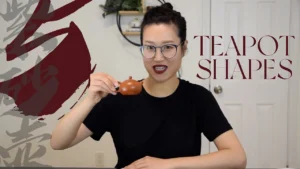
- The standard way to hold a teapot is: thumb and middle fingers pinch the handle, using the wrist strength to lift the teapot. Index finger put on the lid without blocking the air hole. The pinky finger is unused but held close.
Two-handed use: this is a great hold for those who are new to teapots. Using the middle finger of one hand to press again the lid button, the other hand using thumb, index finger, and middle finger to hold the handle. - Whichever way the teapot is held, be sure not to block the air hole.
-

Fang Gu Zisha Teapot
$756.00



Reviews
There are no reviews yet.